Nitobi’s OnAIR European Vacation 
February 21st, 2008
Adobe is at it again with the OnAIR bus tour European leg.
There will be two legs this time one in the west and one in the east.
Of course the most exciting part is that Andre will be joining the party again for both legs and talking about all the Ajax goodness that AIR has to offer. So if you are a Nitobi customer in one of the tour cities be sure to contact us and meet up with Andre!
Posted in AJAX, Nitobi, air, adobe, adobeair | 2 Comments »
Hack Day Hangover
February 10th, 2008
The turnout for Nitobi Hack Day was great!
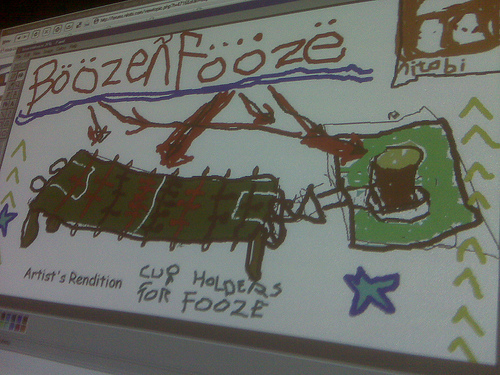
Pretty much all the desks had people hacking and there were five of us around the boardroom table writing code. Hopefully everyone will update the wiki with their names and projects. There was a collaborative flex app, a Rails web application, a blog API written in merb, a Facebook app, foosball cup holders, an iPhone app, declarative YUI components, a command line twitter client, and a few others that my hangover is preventing me from recalling. Hopefully people will update the wiki with the full list.
Ryan had the best hack that was an Adobe AIR application that controlled music being played on a different computer - way cool and hopefully he will polish it up and release it for everyone! For his efforts Ryan won a copy of Adobe Creative Suite Master Collection!
There is still lots of beer left at the office so I am sure that this will be a productive week coming up.
Thanks to everyone who participated and hopefully we will have another hack day in a couple of months.
Posted in AJAX, Flex, Nitobi, hackday, adobeair | 1 Comment »
Ajax Alive and Kicking
December 14th, 2007
I think that people still finding new and interesting features of old browsers is a good sign that Ajax still has some gas left. Even more recently there are developments around charting, comet, sound and widgets. For those reasons I am not convinced that new “RIA” frameworks like Flex, Silverlight and JavaFX are the nirvana that will save us poor web application developers from the hell that is cross-browser JavaScript and DOM development. Even the very idea that Ajax is a cross-browser hell is really a misnomer in this day and age when there are so many different mature Ajax frameworks that take care of a lot of the cross-browser issues Ajax developers have to deal with on a daily basis - Ajax frameworks are to Ajax developers as the Flash player is to Flex developers. Most of the rest of this is to build on what Kevin Hoyt recently posted.
Where Have We Been
Over the past few years both Ajax and Flex have come a long way. Previous versions of Flex (and Flash before that) were nowhere near where Flex 2 / 3 Beta are at and one can achieve amazing things with Flex these days. The same can be said for Ajax. I think that both Flex and Ajax have been moving forward in step. In fact, Ajax has been around for a lot longer than Flex and was already creating real RIAs back in the late 90’s when Flash 3 was still only being used to make website intro’s. Certain frameworks, like Ext, make it simple to create applications with a desktop like feel using splitters, panels and common desktop UI widgets.
What is an RIA
I use the term RIA here with some reservation just because of the differing perceptions of what it really means - sort of like early perceptions of DHTML only being useful for annoying flashing text and simple animations. In terms of Ajax, one needs only look to today’s best of breed Ajax applications such as the Google online application suite including their great spreadsheet and mapping applications, which either don’t have equivalents in other RIA technologies or are simply better than their competitors; most people would choose Google Maps over the Flex based Yahoo! maps any day. Really, other than Buzzword, there are few popular Flex based RIAs (and even fewer that are actually available to the public) and frankly is there anything that much more amazing about Buzzword compared to a Google Doc? Google Doc even “feels” faster and more responsive to boot.
If RIA is about eliminating the page refresh or drag and drop then Ajax definitely has the right tools to create an RIA application. If RIA is about creating a “desktop like” experience then Ajax is definitely an RIA. If RIA is about improving the user experience and usability of network connect applications then Ajax is undoubtedly an RIA. One look at Google Mail and anyone can appreciate that it for the most part loads faster, searches faster, and generally performs far better than a desktop mail program like Outlook. Even in areas that Ajax may struggle, such as video or graphics, Ajax can take advantage of a wide variety of other technologies such as Flash, SVG or Canvas.
Flex Shortcomings
As with Ajax there are a lot of shortcomings to Flex applications. Dealing with the browser back button, search indexing, rendering HTML content are just a few of the problems that face Flex developers - some of them equally problematic for Ajax applications others not.
On the other hand, one of the biggest strengths of Ajax, which is often quoted as a weakness, is that it depends on the fragmentation of browsers and standards. As we know, overspecializing breeds in weakness. While Ajax may change rather slowly due to the glacial pace of browser advances and constant bickering over standards (something that is changing more rapidly now as the browser market becomes more competitive), at least the people doing the standards are less impacted from having budgets, managers and boards to report to - i.e. closed products like Flex are produced by companies that need to make money. Furthermore, any gaps in the technologies provided by the browser vendors are often filled in by the tireless work of Ajax framework developers.
And you know what the best part of being standards based is? You get included in all the coolest new technologies. Can the same be said of the de-facto standards? Well, Opera is doing ok 
Development Process
Flex has a hard time fitting into conventional - and I dare say preferred - web development processes, which will keep it on the fringe for some time to come. The process that Flash and now Flex developers go through when building an application is that they have Flex builder to design their application and maybe write some ActionScript to access some web service endpoints on a server somewhere. Then the developer needs to build their web service endpoints using a different tool (likely Eclipse or Visual Studio). Everything is separated between the client and server only connected by the web service endpoints yet the client side development is still not strictly for a designer but a designer and an engineer need to work on the Flex application. One interesting thing about this approach to development is that it fits in well with the enterprise SOA sort of idea; the Flex app is only a consumer of enterprise services and does nothing on the server. This is one reason that Flex is becoming popular in applications for SAP and Salesforce I think. However, hat is not to say that Ajax has no place in enterprise applications. The one thing that I do really like about Flex development is the declarative approach which few Ajax frameworks have done, I digress.
On the other hand, Ajax developers are used to using one tool for doing their server and client development whether it be Dreamweaver, Eclipse, or Visual Studio. Arguably the most popular Ajax frameworks, notably ASP.NET Ajax and Google Web Toolkit, actually combine both server and client development in one environment. In those environments Ajax developers are able to write server side code (binding to databases, interfacing with external web services, writing server side events, and so on) as well as client side code (CSS, JavaScript and HTML) all in one place. Even better, the server side code often encapsulates all the HTML, JavaScript and CSS required for an Ajax component like a tree or grid making Ajax development a painless and productive RIA endeavour.
Ajax developers also have so many choices between different Ajax frameworks that provide different widgets and various fundamental approaches to Ajax itself. Some are integrated with the server while others are completely client side. Whereas if a developer chooses Flex, they have really only got one option for their framework, their widgets, their tech support and their sanity.
Testing
Unit testing is all well and good but where is the functional test framework for Flex that is Selenium to Ajax? I concede that functional testing is more important for Ajax just because you may be trying to hit four or five different web browsers with your application but it is important for Flex development even beyond just checking for browser nuances.
Mashups
Finally, one of the biggest drawbacks of Flex, and strengths of Ajax as evidenced by the Web 2.0 craze, is the fact that Flex simply does not play nice in the world of the web. Sure you can access data across domains from Flex if the remote server has read permissions set in the crossdomain.xml file, however, in general Flex is not amenable to building mashup applications. There is no easy way to specify some Flex widget and have it dynamically included in another Flex application (probably due to what I say in the conclusion). On the other hand Ajax RIAs are free to use any of the many technologies at their disposal and mashup content from anywhere on the net - including Flex content. Ajax applications were popularized due to the early mashup - in particular maps based ones with Google Maps. Flex is a heavy (handed?), non-standard, monolithic approach to building RIAs that are conducive to keeping the application separate from others.
Conclusion
Ajax is made for the browser and the browser will continue to be the universal approach to accessing content over a network for some time to come. Not the least reason of which is the rule of least power. The web became popular for a reason and that reason is the ease with which content can be created. This is as true for HTML as it is for Ajax and is the main reason that Ajax is alive, kicking and will be around for a while despite new RIA technologies.
Posted in AJAX, Flash, Flex, air, adobe, adobeair | 3 Comments »
Alwees Froosh
October 28th, 2007
That is the name of the application that Jake, Chris and I made for the inaugural Nitobi Hack Day last Saturday.
Yes, we may have had the biggest team and yes some teams didn’t even stick around until the sweet, sweet beer but we came within a whisker of winning it all! Of course, how you split up a single iPod Nano amongst three people is anyone’s guess.
The idea behind the application was that we wanted a desktop app that would be running all the time and would bring in information from many different sources about music artists / bands that you like. In particular, I never know when new albums come out from bands that I like. The trick is that we use, in this case, your top tracks XML listing from Last.fm to determine what you like - ie what you listen to most is what you like. Then we use that info to look up different information about the bands. At the time of building the application we decided on two things to bring in; new releases and events. The original reason that we went with the AIR application was because I wanted to use my iTunes XML file. We found a problem with that early on - my iTunes XML files is >7MB and AIR has a tough time opening it. That is when we decided to go with Last.fm.
I will release the app shortly once I get some time to fix it up.
We were able to deal with the new AIR security model pretty easily and of course chromeless windows and all the great CSS3 support was much appreciated!
Posted in Web2.0, AJAX, JavaScript, Nitobi, air, hackday, adobe, adobeair | 5 Comments »
Hack Day Epilogue
October 21st, 2007
Nitobi Hack Day today was a great success! We had over 35 people in total throughout the day and ended up with about 8 or 10 presentations at the end of the day. Joe Bowser of Nitobi ended up being voted the coolest hack and won himself an shiny new iPod Nano. There was streaming video for most of the day and there will be videos put up on YouTube soon. Tweets can be seen from Andre, Brian, Roland and myself.
At the end of the day the keg of beer was tapped and there was a flury of activity as people tried to put the finishing touches on their applications.
Thanks to everyone who came out and made this event a very fun time! We will definitely be doing it again soon!
I will report on my Adobe AIR hack tomorrow once I get some much needed rest
Posted in Nitobi, RIA, air, vancouver, hackday, adobeair | 2 Comments »


 Entries (RSS)
and
Entries (RSS)
and