- Nitobi
- Built for People
Customer Case Studies
Nitobi Case Study: hyperWALLET
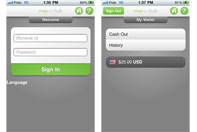
An example of the iPhone app
Some more iPhone screenshots
Screenshots of the iPad version of the app
Services Provided:
hyperWALLET Adds Mobile Apps to the Mix
Vancouver-based hyperWALLET is a payment technology company that offers an easier way for financial institutions, mobile operators and corporations to make international payments. For instance, multinational companies that pay sales commissions to agents around the world use hyperWALLET’s global payment service because it’s easier and more affordable than wiring money or mailing cheques.
In the summer of 2010, hyperWALLET decided to add a mobile app to its product suite. An iPhone app would allow customers to access their payment portals from the iPhone and iPad to view balances, transaction histories and cash out. With a mobile app, customers would have a convenient, immediate way to access their accounts, even while away from their desks. Plus, because hyperWALLET does business in Asia where phone culture is mainstream, a mobile app could give hyperWALLET a competitive advantage in that region.
VP of Product Development Bill Crowley started looking for an Objective C developer to build the hyperWALLET iPhone app. But he had some concerns. “I was worried about outsourcing the whole app knowing there would be ongoing costs for updates and adding features,” said Crowley.
When they were introduced to Nitobi and its open source PhoneGap framework for cross-platform mobile app development, their plans changed. “A trusted and knowledgeable mobile consultant we know referred Nitobi and PhoneGap. With her endorsement we gave PhoneGap a serious look,” said Crowley. They decided that Nitobi would build the initial iPhone app using PhoneGap and would then hand it over to hyperWALLET to maintain and deploy to other platforms.
Nitobi is a Vancouver-based web and mobile app developer. It’s also the creator of PhoneGap. Apps built in HTML, CSS and JavaScript with PhoneGap still take advantage of core features in iPhone/iPad, Google Android, BlackBerry, Symbian, Palm and more. PhoneGap web-enables native device functionality with open standards like HTML, CSS and JavaScript so that developers can focus on the apps they’re building, not on authoring complex platform compatibility layers.
“At first I was a bit suspicious of PhoneGap. I’ve written native apps in Objective C and wasn’t sure that anything outside native development would be as good,” said hyperWALLET software developer Bryce Watson who was assigned to the project. “I also had concerns about how well we could maintain a pure JavaScript app. But, once I saw the framework, I knew it would work.”
hyperWALLET defined the features and requirements. The app needed to be multi-language and deliver the same functionality as the hyperWALLET web portal. Another key requirement was that the app be “brandable” so that hyperWALLET could easily white label versions of the app for their customers.
Using PhoneGap and web technologies, Nitobi built the client-side application and the communications layer that integrated with hyperWALLET’s web services, as well as a visual theme. Nitobi put a framework in place that makes it easy to brand the app–a few quick changes to the CSS theme and the application is skinned for any brand. With a few modifications to a settings file, the application enables or disables features and points to the appropriate web service. This makes it easy for hyperWALLET’s in-house developers to quickly customize the application for any client.
Nitobi stayed within budget and delivered exactly what they promised. “Hiring Nitobi was a great decision,” said Crowley. “They listened well and delivered the app we wanted.”
“I was very happy with the level of service from Nitobi,” said Watson. “Ryan Willoughby, who built the app, was responsive and helpful. I also received training so that I could run with the app on my own.”
From there, the app was passed on to Watson to maintain and deploy on new platforms. The PhoneGap skills transfer was thorough. He participated in a couple of training sessions with Nitobi developers and contacts them if questions arise.
Since taking full ownership of the app, Watson has found further development with PhoneGap fast and easy. When hyperWALLET recently added a new prepaid Visa feature to its portal, it took Watson just one day to add the feature to the mobile app. “The PhoneGap framework uses well-known architecture, so it’s intuitive,” he said. Despite being new to PhoneGap, only 20% of his time is spent on the app, not just maintaining it, but building new features too. The mobile app has become a key part of hyperWALLET’s product development roadmap.
Thanks to PhoneGap, hyperWALLET now has a mobile website, an iPhone/iPad app and soon an Android app, created all from the same codebase
According to Crowley, their newly gained PhoneGap knowledge may even open up opportunities for a mobile app development business unit for hyperWALLET where they take on building PhoneGap apps for their customers.
- Counterpoint
- CTP
- hyperWALLET
- Jiibe
- Jistik
- Overlay.TV
- RNAO
- Schenker
- Scrutinizer
- Sosido
- Tabrio
- Vancouver Aquarium
- VanGuide
- Webex
- Work at Play
“I was very happy with the level of service from Nitobi”