- Nitobi
- Built for People
HTML Select tag unsupported in Palm WebOS application framework | May 25th, 2010
A recent blog post by Steve at http://globalconstant.scnay.com/ revealed that HTML Select elements were not working in PhoneGap Palm … and after a quick test it appears that they’re not supported by WebOS at all. I scoured the internets trying to find this documented or discussed, and all I found was someone else mentioning it in the Palm Developer Center. This is quite surprising and a bit frustrating to know that such a basic HTML element is unsupported, and really messes with the cross-platform support of PhoneGap. It also gets me wondering what other HTML tags are unsupported.
The select element is rendered (though it is ugly, supporting the theory that this element is unsupported by webOS), but cannot be interacted with. I’m guessing that the custom Tap events used by Mojo are unimplemented on it.
Ideal world solution: Palm fixes this and gets it out in an upcoming release.
Real world solution: I start experimenting with ways to fix this. Would love to hear from the community on suggestions … but really the solution that comes to mind is that PhoneGap, during initialization, finds all the html select elements and replaces them with Mojo List Selector elements. Even at first thought, I see some hurdles:
– we will have to copy over all of the style and class attributes … but these may have an unexpected effect on the look of the widget, since the Mojo List Selector consists of html elements with internal Mojo css classes.
– we will have to implement the standard javascript events, if they are not already available, such as onchange, onfocus, etc.
So I hope to get some time to experiment with this soon, and see if I can sort it out. And hopefully not find out that there is a list of html tags unsupported by webOS.
PS — Suggestions appreciated!
UPDATE: I fixed html selects (basic functionality) for PhoneGap Palm, and the code could easily be ported to a non-PhoneGap WebOS app needing functional selects. It just shows a Mojo SubMenu, and manually changes the select’s value, as well as calling the onchange event. Check it out at http://github.com/phonegap/phonegap-palm/blob/master/framework/www/app/assistants/First-assistant.js.
Update on PhoneGap Symbian & PhoneGap Palm | May 21st, 2010
I’ve been a bit inactive on PhoneGap recently, as we’ve had some client projects on the go. Need those $$ to keep the open-source projects rollin. But since its been a while, I wanted to give at least a status update on the PhoneGap platforms that I maintain.
There have been some updates to the PhoneGap Mobile Spec, so I’ve re-run them on WebOS and Symbian (see below).
-
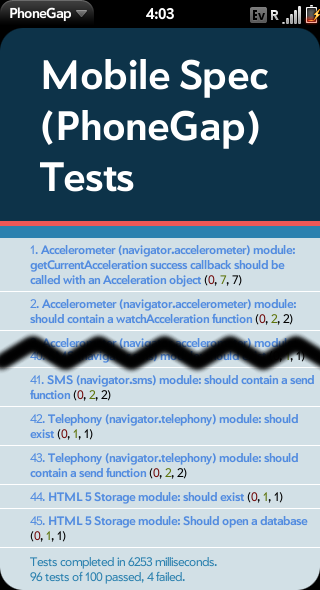
- PhoneGap mobile spec results on Palm Pre
-
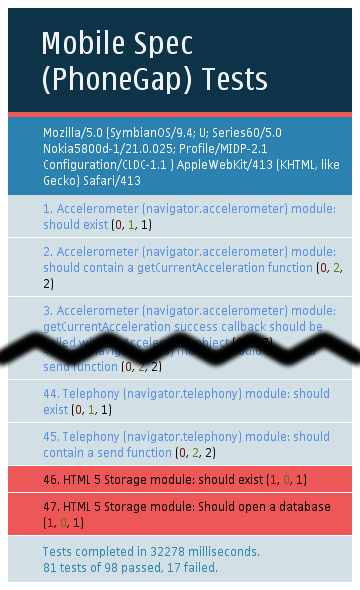
- PhoneGap mobile spec results on Nokia 5800 XpressMusic
96 / 100 on Palm:
Contacts fails, as a full device contacts api is not available to us in WebOS (discussed in an earlier post); some of the device info tests fail, as we can only provide device properties that are provided to us by the device (not much we can do here); Network.isReachable fails, I believe because this spec has been updated to return a network status ‘code’, rather than the previous return value of just ‘true’ or ‘false’. I’m going to fix up the Network api, hopefully today … but we’re looking pretty good on Palm. And Palm devices are really nice, and very quick and easy to deploy to. I highly recommend trying it out, even in their emulator (also really nice).
81 / 98 on Symbian Web Runtime:
HTML 5 Storage fails: not available in WRT, and can’t really implement SQLite in javascript  ; Network reachability fails, as WRT provides no API for this (however I’m going to revisit this as I figure their should be a way to do this); File I/O fails, as WRT does not provide access to the file system. Basically after running these tests (and having them crash regularly, I think due to running out of memory), I’m thinking more and more that PhoneGap Symbian using Qt for Symbian is the way to go. WRT is a great tool, for lightweight apps, but its performance is not good. Javascript animation simply can’t be handled, and extensive sensor interaction will crash the application. Initial tests on PhoneGap using Qt for Symbian were much better. Not to say we should drop the WRT implementation overall, as it does meet certain needs.
Update on PhoneGap port to Qt for Symbian | January 15th, 2010
After getting distracted for a while from my port of PhoneGap to Qt for Symbian, I’ve recently jumped back on it, tightening it up a bit and adding some APIs. We now have Geolocation, Vibration, Acceleration, & Orientation working.
Now we already have a Symbian port of PhoneGap working and available, which uses Nokia’s Web Runtime (WRT) technology (which is native to Symbian OS). So why PhoneGap on Qt for Symbian? Well I briefly mentioned some of the limitations faced by using WRT in a previous post; I will touch on those again and expand:
- It is a closed-source proprietary technology, so we cannot actively fix bugs, and we cannot add features (and we want PhoneGap to be open!),
- Performance: when I ported a PhoneGap application developed and tested on the Palm Pre to PhoneGap Symbian WRT, I found that its javascript animation was completely lost. It would get from state A to state B, but the animation in between was non-existent. I originally assumed my phone simply could not handle the animation … until I tried it using PhoneGap Qt for Symbian. It worked.
- Memory: I tried using prototype.js in one of my PhoneGap WRT applications … it would crash immediately upon opening the application simply from the volume of javascript being loaded. Which reminds of when I first started developing with Web Runtime, and my applications would intermittently crash. Initially I would be chasing down the line of code which was crashing the environment … until eventually it became clear that we were simply running out of memory. Wasted a fair bit of time looking for non-existent bugs.
Now PhoneGap Symbian for Qt is still young and perhaps as it grows, it will face the performance & memory issues mentioned above. But for now things are running much smoother.
So far my testing of PhoneGap Qt for Symbian has been limited to my little PhoneGap API demo app, so more testing is definitely on my plate. The platform uses Qt Webkit, which appears to be very modern and so far has worked very nicely for me. Flick-scrolling is not native to the Qt Webview, so I may have to try implementing that as well. But to summarize, PhoneGap Qt for Symbian is now available, though not yet API-complete. Clone it, Get Started, and let me know if you have questions, comments, or suggestions. Or contributions!
PhoneGap Palm now available | December 7th, 2009
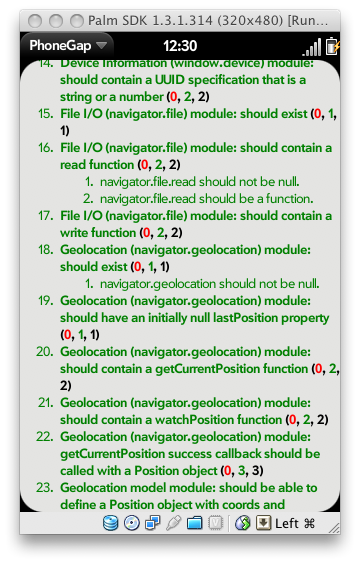
I just pushed my latest work on PhoneGap Palm to my github repo, and it should be pulled over to the main phonegap repo shortly.
PhoneGap API’s available to Palm devices include geolocation, accelerometer, notification, orientation, sms, telephony, network, file (read only), and a limited selection of device properties (see the PhoneGap Mobile Spec running on the Palm Emulator to the left).
Unfortunately the contacts API won’t be available for a while, due to the fact that the Mojo API limits data access (including contacts data) to that which was created by the app in context (see this discussion). Hopefully this will change.
For those who don’t know, Palm’s webOs is completely based on web technologies. We’ve got a couple of Palm Pre’s here for testing, and they’re sick. And the edit/deploy/test cycle is very smooth. You can test on device and write to a debug console which you can monitor on your SDK console.
Like we did for Symbian WRT, we simply had to write a javascript shim to map the Mojo API (webOs’ mobile js API) to the PhoneGap API. I also had to do a bit of messing around with the stage/scene system which they use for changing application views. But its ready for use with the device APIs listed above.
I’ll be continuing to work on this and expand the API, and I also hope to get some time to continue my work on PhoneGap Symbian/Qt.
PhoneGap Symbian: Qt 4.6 for Symbian officially released | December 1st, 2009
So after starting off with Qt 4.6 tower, then upgrading to colossus ), then a beta release candidate, the official Qt 4.6 RAMBO release is here! Well its not called Rambo but it should be. Its got solid Qt Support, though I haven’t upgraded my PhoneGap Symbian fork yet, but will shortly. I was hoping we might have the Qt Mobility packages built into the release but I guess there’s still some work to be done on them. For now I’ll have to continue to include the different libraries via source code, which isn’t a big deal.
Brian fowarded me a twitter post of someone who was confused how Qt gets installed on the device … its a sis installer file, just like most other tools and apps (save WRT Widgets). Sis installers can encapsulate other sis installers, so I was thinking Qt could be packaged with PhoneGap apps for deployment. Maybe if developers really start making apps using PhoneGap Symbian with Qt, Symbian will ship with Qt …
There may be some confusion as to how PhoneGap Symbian Qt will be built and deployed, so here’s a bit of a step by step of what’s required (detailed version):
1. Install the S60 (Symbian) SDK, Qt 4.6 for Symbian (SDK first, Qt patches it), and their various associated prerequisites.
2. Download the PhoneGap Symbian source code, which which will include the required Qt Mobility APIs.
3. Build your webapp using html/js/css and the symbian phonegap.js, and place it in the phonegap/symbian.qt/framework/www/ folder.
4. Build and in the emulator, if desired.
5. Qt 4.6 includes qt.sis. This installs qt to your symbian phone. Do it.
6. Build your application, which will give you your application.sis (self-signed). This will be your distributable. Voila.
Outstanding issues:
– cannot send xhr’s from our local resources (priority)
– many API’s still to be implemented
– Symbian Signing
Feel free to post comments if you have any questions.
PhoneGap for Symbian: Qt | November 18th, 2009
During the initial stages of working on PhoneGap for Symbian using Web Runtime, some limitations were brought to light due to the fact that Nokia’s WRT is closed source: we are limited to the device functionality and platform support which Nokia has exposed. Nonetheless its a great technology and porting PhoneGap to WRT was a relatively quick win (taking in to account my having to re-learn javascript after 1 year of flailing abroad).
But over the last few weeks, while maintaining the latter, I’ve been researching/experimenting (don’t even want to go far as say developing, as very little has been implemented) with Qt for Symbian. The crew at Nokia just released the Qt 4.6 release candidate on Nov 17th, and it includes a port of Webkit to Qt (QtWebkit), along with support for the Symbian/S60 platform, which is just the combination phonegap needs.
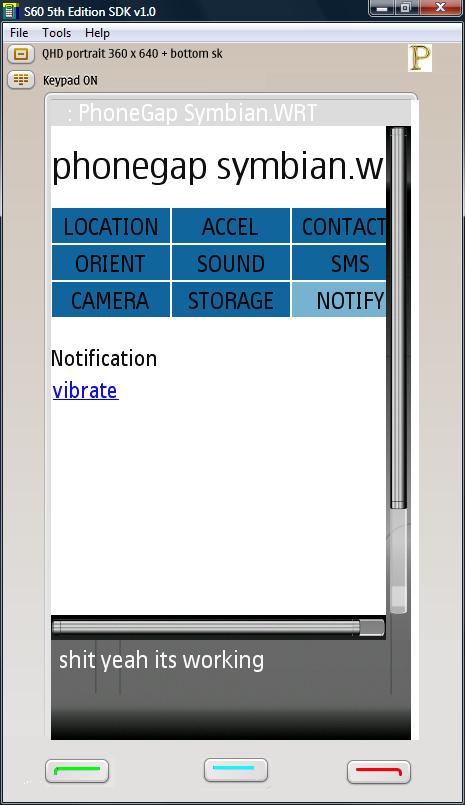
note my amazing javascript console, firebug is crap
So anyways I’ve got a PhoneGap Symbian Qt build (piggybacking off of the webkit demos included with Qt) which can open a local resource in a webview, and expose Qt Objects (and thus device functinoality) to javascript (via webframe->addtojavascriptwindowobject). I’ve implemented the most important API first, rather than the easiest: vibration. Ok it was actually the easiest.
Anyways there’s other problems to tackle before implementation of more PhoneGap APIs:
- XHRs seem to be getting blocked. I’m thinking its blocking what it considers a cross-domain XHR: a local html file to a remote server. I believe the support of this depends on the Webkit implementation(?)
- I can’t remember what else.
So if this looks interesting, help out the mobile developer community. Contribute. Its open source. Check out my very basic Getting Started doc, and get the code from my PhoneGap repo on Github (Symbian Qt branch). The .sis installer file is in there as well, so you could also just put it on your device to see a PhoneGap app that vibrates and thats about it. Really useful. I think you might need to install Qt libraries to your phone since I haven’t packaged them in the app yet.
twatter | November 4th, 2009
my refusal to join twitter was reaffirmed when Andre sent me this
Tcktcktck (made w/ phonegap) available in ovi store | November 4th, 2009
The Tcktcktck mobile application is now published and available in Nokia’s Ovi Store to a selection of several S60 5th Edition devices. I believe it was recently approved in Blackberry’s app world, so once the iTunes Store sorts itself out, we’ll have a bit of a success story using PhoneGap for cross-platform mobdev!
PS the canucks are winning with half their forward lineup, plus luongo, injured. Bieksa even played forward last night haha! they’re makin a run.
PhoneGap for Symbian.WRT follow-up | November 1st, 2009
To follow up with my last post, the WRT javascripts for phonegap symbian are now up on my github account: http://github.com/wildabeast/phonegap
Will get sintaxi to pull soon. But feel free to play with it for now. Nokia’s WRT (on Symbian OS) is real easy to use, especially with the PG libraries in there.
Recently added libraries include: camera, sms, orientation, storage, and acceleration.
Search Posts
You are currently browsing the archives for the Uncategorized category.
Pages
Archives
- April 2009
- November 2008
- September 2008
- August 2008
- July 2008
- June 2008
- May 2008
- April 2008
- March 2008
- February 2008
- January 2008
- December 2007
- November 2007
- October 2007
- September 2007
- August 2007
- July 2007
- June 2007
- May 2007
- March 2007
- January 2007
- December 2006
- November 2006
- October 2006
- September 2006
- July 2006
- June 2006
- May 2006
Categories
- .net (6)
- agile (2)
- air (8)
- ajax (34)
- analytics (3)
- apple (11)
- as3 (2)
- asp.net (3)
- basic (2)
- branding (3)
- business (28)
- coldfusion (2)
- components (13)
- conference (6)
- culture (4)
- Dell (2)
- documentation (8)
- enterpriseajax (3)
- events (18)
- firefox (5)
- flash (5)
- flex (6)
- gmail (1)
- graphic design (9)
- gwt (1)
- ie6 (3)
- ie7 (4)
- ie8 (3)
- iphone (7)
- java (1)
- jquery (1)
- linux (1)
- media (6)
- microsoft (7)
- mootools (1)
- mysql (1)
- nitobi.com (4)
- onairbustour (3)
- opera (2)
- php (2)
- politics (3)
- project management (1)
- resources (26)
- review (2)
- Rich Internet Apps (12)
- robotreplay (5)
- ruby (1)
- rubyonrails (9)
- safari (5)
- search (2)
- security (1)
- silverlight (1)
- socialnetworking (1)
- Uncategorized (6)
- User Interface (20)
- web development (46)
- web2.0 (24)
LinkedIn Profile
- My Profile