- Nitobi
- Built for People
Customer Case Studies
Nitobi Case Study: Work at Play
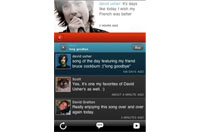
David Usher’s profile on DEQQ.
An example of posting using the DEQQ app.
Nelly Furtado’s profile on DEQQ.
Services Provided:
Nitobi Mobilizes the Deqq Music Experience
Work at Play creates digital experiences for the engagement generation. Recently Work at Play has invested in taking fan engagement a step further than sites like MySpace with a service of its own called DEQQ, a branded, integrated platform that enables social media-savvy consumers to build “tribes” around their favourite musicians. DEQQ connects artists with people who care about their music, and makes it easy for fans to find one another.
On content-focused sites like MySpace, comments are attached to a post. Work at Play wanted to develop an experience centered on the fans and their conversations, not on specific posts. First, Work at Play tried a Twitter-based approach, but after a conversation with 15 fans became a fire hose of comments in just ten minutes, they realized that the Twitter architecture wasn’t the right fit for fan dialogue. They needed to rethink how those conversations worked, so Work at Play started with a threading architecture that would enable each element created by fans to take on its own life as a discrete object on DEQQ.
Work at Play’s founder, David Gratton explains, “The whole purpose around DEQQ is to connect an artist with people who care about their music and art, as well as for fans to find other fans. It’s the fans who are critical to the formation of of a viable artist community–the artist is the common interest, but fan interaction is the life blood of any artist’s community. Considering the competitive market place for online media services, we made DEQQ easy to configure and install. In less than five minutes an artists can have his whole community designed, deployed, and connected to their social graph. Their community will be rocking on the very first day of operation.”
DEQQ calls each community a “channel”, and inside each channel fans can comment, start a thread, listen to music, buy music, and share their own media. They can also broadcast this content into their Twitter feeds and Facebook profiles.
With DEQQ, the artist can reply to a number of comments on any individual thread, rather than having to reply to every comment. This fills the channel with noise and is too time consuming for the artist. Fans feel a real connection with the artists, and artists don’t suffer from social media fatigue trying to respond to every tweet or wall post.
Work at Play approached Nitobi to create a version of DEQQ for the iPhone. A mobile app was a natural next step as many DEQQ participants also have smart phones, and part of the music experience is attending live shows. Nitobi’s expertise in mobile application software made them a natural choice. Gratton continues, “We’ve wanted to work with Nitobi for a long time. Their PhoneGap open source program was where I wanted to go. I like the whole concept of it – it’s ‘webby’. Mobile apps will migrate to Web centric technologies, and with Nitobi’s PhoneGap, applications written in JavaScript and HTML will run on multiple platforms, like iPhone, Blackberry and Android.”
Nitobi ported Work at Play’s initial desktop application of Deqq to the iPhone. This was a non-trivial matter, in part due to DEQQ’s unique ‘card’ metaphor. Cards function like tweets, but can contain embedded media, and are threadable. They can be sorted in real-time and filtered for specific media types. Nitobi’s development team did considerable research to determine out how to make these cards “webby”. Rather than simply resort to platform specific technologies on the iPhone that would have made the problem easy to solve, Nitobi employed cross-platform technologies–a surprisingly complex technical challenge.
Senior Nitobi Developer Jesse MacFadyen said a challenging aspect of the Deqq project was rendering large datasets in mobile browsers. To achieve the right result, Nitobi fine-tuned HTML outputs to ensure that scrolling would be smooth, even when there are hundreds of elements on a page. Additionally, Jesse and his team used a three-tier approach within the JavaScript to minimize the time it takes to refresh data and call the server. “This was one of the first large scale data rendering PhoneGap applications, so we had to do some experimenting. As a result we chose to write out all the HTML using templates and Regular Expressions.”
While the DEQQ project presented some unusual technical challenges in managing the incoming flows of information, Jesse and his team were happy with the end result. “We’re very pleased with DEQQ unique blend of PhoneGap/HTML with native extensions for commenting and audio playback.”
The next stage for DEQQ is to add more platforms, such as Android and RIM. Right now, DEQQ has been somewhat music-focused, but it was designed broader, more general uses. Amnesty International and Emily Carr University are using DEQQ for both community outreach and classroom engagement.
“This was a challenging task: ensure a unique interactive interface developed in AIR could be developed in HTML and JavaScript on a mobile device. At points I was concerned about our ability to meet that challenge, but Nitobi said they were going to get this right, and they pulled out all the stops to make it happen. I’m very happy with the result. It was the right choice to work with them.” David Gratton, Work at Play Founder.
- Counterpoint
- CTP
- hyperWALLET
- Jiibe
- Jistik
- Overlay.TV
- RNAO
- Schenker
- Scrutinizer
- Sosido
- Tabrio
- Vancouver Aquarium
- VanGuide
- Webex
- Work at Play
“Nitobi pulled out all the stops to make it happen.”