Skip to Navigation | Skip to Content


Archive for the 'design' Category

Ajax Survey - Win an iPod Nano | January 21st, 2008

We’re
running a survey this month to gather information from web
designers and developers about the tools and platforms they’re using. It’s quite focused on development of Ajax user interfaces.

If you can spare three minutes, I’d appreciate it if you href="http://www.surveymonkey.com/s.aspx?sm=bpDcVkz3gpWM1sBwcNAAMg_3d_3d">completed
the survey. It’s pretty brief-14 multiple choice and short answer
questions. One person who does will win an iPod Nano. We’ll be
publishing the survey results in February. So everyone wins really:)

Posted in AJAX, Business, design, Enterprise Ajax, Software Development, Technology | No Comments » | Add to Delicious | Digg It

What Do Your Eyeballs Actually See? | December 28th, 2007

We all have some vague notion that we can’t visually focus on everything in our field of vision at once, but just how little can we really see at once? This is a very important question for web designers and information architects. James and I are working with Andy Edmonds of StomperNet to build a browser type application “that simulates the limited high resolution vision available to humans as they use the computer”, called or
Foveal Gaze Simulation Software Scrutinizer.

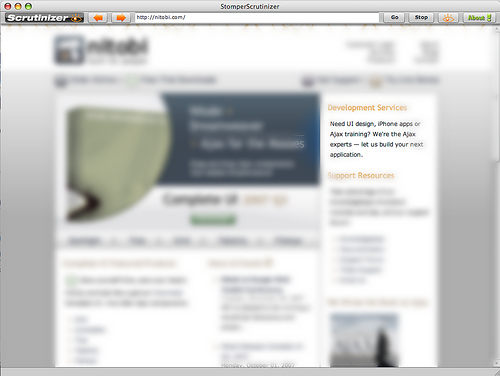
Scrutinizer Screensot

Basically the app applies a filter over the web page your viewing that allows the region around your mouse to be in focus, while the rest of the screen is blurred out. This is to illustrate the difference between what your fovea and periphery of your eye see. This way you can see what your users see more or less and apply some usability best practices to improve conversion or generally make your site easier to use. Specifically you can make adjustments like button positions, whitespace, navigation bar headings and typography. The idea is to use the science behind vision to improve your site without really needing to understand it all;-)

James built this app with AIR. Using the HTML functionality to implement a simple browser and Flash to create the filter over the web page. We had a few interesting challenges getting the page interactions and events to work through the Flash filter, but it’s working pretty well now and will only get better:) On interesting feature you might miss is that you can adjust the size of the focused region with the mouse wheel. This simulates the narrow detailed foveal view when zoomed vs the larger less focused foveal view for rapid scanning when zoomed out.

The masses really are starting to think that usability is cool, even Scoble plugged Srcutinizer! Quick buy some shares in user experience!

Scrutinizer is free, so go download it.

[Update] There’s a super handy Top 10 uses for Scrutinizer posted on the site that includes suggestions simulating eye tracking in a usability study, testing findability, assessing the ease of a multi step process and more.

Posted in AIR, AJAX, Business, design, Flash, nitobi, ria, Usability - HCI, Web 2.0 | 1 Comment » | Add to Delicious | Digg It

Robot Replay Mentioned in the Montreal Gazette | December 28th, 2007

Web designers can watch how visitors behave on sites

What are you looking at?

Sometimes, website designers don’t see the flaw of their own creation that deters a site’s visitors. They are so familiar with the site they built that they think everyone will be able to use it as easily as they do. If you want to see how people are really using your web pages, use Robot Replay to watch them interact with your site.

It’s neat to see RobotReplay picked up by some mainstream media…I wonder is that means it has a much broader appeal than we first thought. I do feel like usability and user experience are hitting main stream vogue, but I may be stuck in an echo chamber. Help;-)

Posted in AJAX, Business, design, nitobi, ria, robotreplay, Software Development, Usability - HCI, Web 2.0 | No Comments » | Add to Delicious | Digg It

Great Tips for Better Web Form Design | December 8th, 2007

I just finished reading through Luke Wroblewski’s slides on form design. It may seem like a mundane topic, but when you considered most applications are a series of forms strung together it becomes very relevant. And more so if you’re an ecommerce site or site trying to get users to sign up via a form. Luke’s done research on label position (left aligned, right aligned, above the text box) and made recommendations on when to use each convention. He also looks at how to use required fields, how to group fields, use tabs and backs it up with really usability testing and eye tracking evidence!

Best practices, backed up with real world research. This is a must read for anyone even remotely connected to the development or design of a web form. Come let’s get users through those forms quicker! Luke has lots more great design and usability tips over on his blog Functioning Form. Luke also has a book on form design coming out next which I’m looking forward too called Web Form Design Best Practices.

Posted in AJAX, design, Software Development, Usability - HCI | No Comments » | Add to Delicious | Digg It

Ajax Risks on ComputerWorld | November 2nd, 2007

Although we’re all building Ajax applications, tools and framework at break neck speeds it’s probably wise to pause once in a while to consider the potential risks.  As with any technology there is good and bad.  You don’t want to take a wrong turn that could jeopardize your software development project or even your business.  For a sober look at the risks associate with Ajax projects check out Alexei White’s article “Are you ready for AJAX risks?” on Computer World.

The 3 main areas of risk are:

Technical — These are issues that directly relate to the design, development and maintenance of software, including security, browser capabilities, timeline, cost of development and hardware, skills of the developers, and other things of that nature.

Cultural/political - These are fuzzy issues that focus around the experience of end users, their attitudes and expectations, and how all this relates to software.

Marketing — These are issues that relate to successful execution of the business model resulting in sales, donations, brand recognition, new account registrations, and so on.

This article is republished from our book Enterprise Ajax. We finished writing the manuscript for the book and therefore this article almost a year ago and some stuff has changed. For example we now know what Safari 3.0 looks like under the hood. However, much of this article will apply to more than Ajax projects, so it’s worth a read.

One big risk that I think is more relevant now than ever is whether or not Ajax is the best or only technology you should be using to achieve a rich user experience online. Food for thought:)

Technorati Tags: ajax, risks, development, technology, challenges, enterpriseajax, book, computerworld, seo, marketing

Powered by ScribeFire.

Posted in AJAX, Business, design, nitobi, Software Development, Technology | No Comments » | Add to Delicious | Digg It

Can Flash and AIR make the Browser and Operating System Irrelevant? | October 22nd, 2007

I’ve pondered for a while where all this rich web and easier desktop development stuff is headed. I have a couple ideas:

1. Flash player could make your browser irrelevant much like the web browser makes your personal computer irrelevant.
2. AIR can do the same thing for the operating system irrelevant

Let me me explain this in a little more detail. The browser makes your operating system irrelevant (or less relevant) because you can access web based applications from a standard web browser the same way whether you’re on Mac, Windows or Linux. If I use MS Office, like I used too, I’m committed to windows, switching to Mac would be a pain.  If I use Google Apps, I  currently use Gmail and some Google Docs (but not exclusively) I can switch to any operating system or computer for that matter and booya all my tools and data are already there. The only catch is that the browsers do have slight differences that create a significant amount of work for the developers. The Flash player is evolving faster and faster. the browser is stagnating not due to technical challenges but due to battles between vendors and infighting within open-source projects. No single browser has the same mass adoption as the Flash player. Flash is one run-time, not cross-browser. Just having to develop for more than one environment (IE, FireFox, Safari, Opera, Barf!) should make that self evident. Although this went mostly unknown in both the Ajax and Flash/Flex communities, there was talk after the last Ajax Experience to run WebKit inside of the Flash player (like AIR does kind of) and run all your Ajax in there. One HTML renderer across all browsers via Flash. Ironic eh.

Their proposed solution is this:

1. You make a web page using HTML, CSS and JS as you do today.
2. You test it in ONE browser. Probably WebKit.
3. You include a single JS at the top of your page, a spinoff off of SWFObject.js
4. The JS would instantiate a SWF file which would fill 100% of the height and width of your browser window.
5. The JS would then suck in the HTML of the page, and feed it to the Flash Movie.
6. Then the Flash movie would instantiate WebKit inside it and render the page.

OR

1. Same as above, but instead of a Flash movie, it would be a WebKit native plugin.
2. This would need it’s own JS that was specific to this task.

Sounds like crazy Adobe marketing speak doesn’t it?  Well this was proposed by a group including Brad Neuberg, Glen Lipka and Alex Russell.  None of whom are Adobe fanboys, and open-source advocates to the end. This is totally feasible especially with the advances they’re making in the Flash player and converting C code to Action Script. So there you go our just barely “good enough” technology, Ajax, leveraging the far superior Flash for it’s ubiquity and uniformity to run everywhere.

A similar thing may happen with AIR.  While the war between Windows, Linux and Mac wages on users and developers won’t care, they’ll just turn to AIR.  But AIR isn’t powerful enough to build “real” desktop apps you say?  So what!  Sure it’ll be a while before we have Halo 3 or PhotoShop running and performing in Flash/Flex/AIR, maybe less than a decade though according to Bruce Chizen.  We already have word processors, Wii style games and image management/editing which my grandmother and the lions share of all computer users need and/or use.  I bet Adobe will have more desktop installs of Webkit with AIR than Apple with Safari.  I think a few things have really accelerated Flash penetration in last few years namely video and advertising. I don’t know what the killer driver for AIR adoption is going to be yet.

AIR, Flash/Flex and Ajax can all have a very similar development models, which are already widely used. How many people do you know who can write a little HTML or maybe even Flash?  Probably a few to a lot depending on your scene. How many people do you know who can write Java, C++ or .Net? Probably not as many. Ajax already has one of the fastest uptakes and steepest growth curves of any development technology. When you combine this with the ability to switch at runtime from Ajax to Flex with the same markup, you can imagine hybrid Ajax/Flex developers becoming the norm. So now we’re looking at nearly ubiquitous runtimes and development models. Then you combine the ease of development of the Ajax or Flex world with the power to run existing C code that can run anywhere, well that’s hard to beat.  I guess the one downside is only that one vendor can control most of it, which we’ve experienced before.

I think with a little better tooling, some interesting cross pollination and some innovative companies we could be in a very different place in the near future.

One thing is for sure, the cost of switching applications from a consumers perspective is quickly approaching zero as you’ll be able to run any application or any operating anywhere! Which means user experience becomes king!

Technorati Tags: ajax, flash, flex, air, adobe, webkit, browser, operatingsystem, windows, linux, mac
Posted in AJAX, design, Software Development, Technology, Usability - HCI, Web 2.0 | No Comments » | Add to Delicious | Digg It

Building a Mac Dock like Menu in AIR with Ajax | August 21st, 2007

So I’ve been cruising on the Adobe AIR Bus across the country this summer and I’m the only guy with a PC, well Ben and Lee were back up for a bit but not consistently enough. So Alexei and I thought it be cool to build a Mac dock type menu for AIR using the Nitobi Fisheye Ajax component.

Mac Dock:

I thought it would be a neat demo too since it’s flashy (nice graphics, animation etc…) and we have some new Dreamweaver Extensions coming out soon which makes it accessible to those aren’t yet full blown “Ajax Engineers”.

First off, so we all know what I’m talking about check this little video of it below:

Here’s how to build it (Dreamweaver + Nitobi Style):

  1. Use the Nitobi Fisheye Component (Dreamweaver Extension) this set ups the Ajax component on the page, and configures the component by setting the properties for display, animation and images:
  2. Sets up the Declaration:


    …You get the idea, this repeats for all the menu items.

  3. Includes the script and CSS


  4. Onload Function
    function onLoad()
    {
    nitobi.loadComponent("myEyeObj");
  5. Add a a function to call when the a menu item is clicked to open a new AIR window and load a given URL.
    function runWindow(wid) {
    var bla = window.open("http://" + wid, wid, "width=800, height=600"); }
  6. Add the capability to click and drag the app around the screen when the bar above the menu is clicked with the mouse.
    nitobi.html.attachEvent($("grabby"), "mousedown", function() {window.nativeWindow.startMove();});
    ....
  7. Then Package as an AIR application with the System Chrome set to “None” and set it to “Transparent”.
  8. More Info and files. Download the code and AIR file to play around with it.. Check out Alexei’s original Ajax Fisheye post.

    Technorati Tags: ajax, air, nitobi, adobe, onairbustour, component, fisheye, macdock, dreamweaver, extension

Posted in AJAX, components, design, nitobi, Software Development, Technology | 2 Comments » | Add to Delicious | Digg It

Web Usability 2.0 Video | June 16th, 2007

Just finished watching a great discussion from some of the leading designers in web usability and interface design.  The topics include:

  • design
  • information architecture
  • usability as a component of user experience
  • usability testing
  • qualitative and quantitative measurement
  • how to roll out changes
  • when to use Ajax
  • wire framing and prototyping

It’s long though, 2h30m so make some popcorn.

The event was hosted at Google:

Usability 2.0 WebGuild Event - April 11, 2007 Luke Wroblewski, Senior Principal Designer, Yahoo! Inc. Jon Wiley, User Experience Designer, Google, Inc. Sean Kane, Director, User Interface Engineering, Netflix Reshma Kumar, VP, WebGuild

Luke’s slides are here.  There’s a few interesting slides in here that are hard to see in the flash vid.  Although none of the actual presentations or panel questions were anything special, I really liked the discussion and questions amongst the three of them.  Although they all design for the biggest properties on the web they all approach usability an ux very pragmatically and most what they discuss could be used by a team of any size.  All smart guys with lots of experience, worth listening to.

[update] Luke has done a follow up interview with Webguild.

Technorati Tags: ux, usability, webguild, ajax, design, testing, web, webdev, google, yahoo, netflix

Powered by ScribeFire.

Posted in design, Software Development, Technology, Usability - HCI | 2 Comments » | Add to Delicious | Digg It

Speaking at Massive Tomorrow | March 27th, 2007

I’m going to be speaking at Massive tomorrow about blogging for business, also of note is that my good friend and adviser Duane will be speaking about Flex. I have still have a couple free tix, if you wanna come just leave a comment here. Hope to see you there.

Technorati Tags: massive, massive07, blog, business, flex, andrecharland, duanenickull

Posted in AJAX, components, design, Software Development, Technology | No Comments » | Add to Delicious | Digg It

Adobe CS3 Launch Event | March 27th, 2007

It’s on now: Adobe : CS3 Launch event webcast.

What Ajax developers might find interesting in Dreamweaver for CS3 from the demo.

  • Checks for browser incompatibilities (IE, FF, Safari etc..)
  • CSS Advisor - section of Adobe’s site, community based for browser differences.
  • Ajax
  • Spry is integrated (no more hand coding)
  • Drag and Drop widgets (Menus etc..)

This webcast is covering a lot of ground so focus on DW was light…obviously.

Check it out:)

Technorati Tags: adobe, cs3, launch, webcast, photoshop, flash, dreamweaver, design, web

Posted in AJAX, components, design, Software Development, Technology | No Comments » | Add to Delicious | Digg It


Search Posts

Twitter

Flickr Pics

www.flickr.com

You are currently browsing the archives for the design category.

Archives

Categories
